Sunday, 24 January 2010

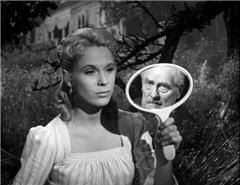
Wild Strawberries

"I hope I never get old so I get religious"

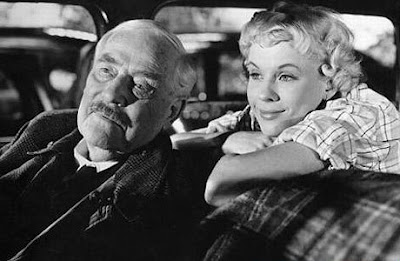
This is the first film I watch by Ingmar Bergman and the trailers from his collection look great!The story is about an old doctor (Isak Borg), who is called to receive an honorary award after 50 years of medical practice in Lund. Essentially, it is a road movie that portrays a man, who realizes how estranged he has been from his son all these years. His daughter-in-low is there as well to enlighten him that she plans to break the cycle of coldness and empty existance in
the family.


Dr Isak Borg visits a number of places that hold precious memories of his c
hildhood and adolescence. He has always been busy doing something else,instead of enjoying the company of the ones he loved. One of the places is a strawberry lawn, where he fe lt in love and lost his lover because of his brother. He meets three youngsters going away traveling and a married couple with problems. They all end up in his big car and through them, he relives some of the sorrow he'd had,as well as the best years of his youth.
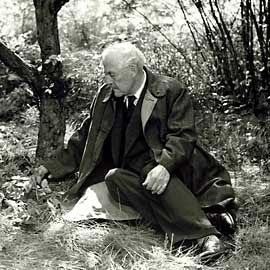
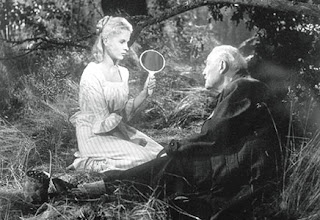

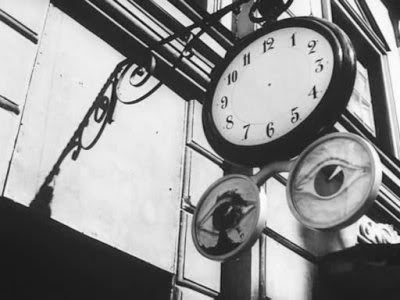
I love the part in the beginning, when Isak has a nightmare of being death. It features stunning elements from the German expressionism and it makes you read the frame, be active in the process of watching. In a way, this film makes me very calm through the use of white colors, but also provokes interest to find out what is going on deep under surface.
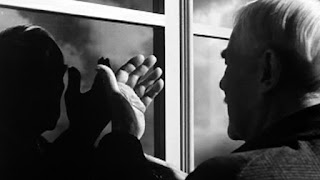


When Bergam has made this film, he though it was about a doctor with certain flaws and that was all. Later on he admitted to himself, it is actually exploring his own family. It is interesting how much our lives influence the films we make, without realizing. In screenwriting, they make us admit out darkest secrets, so we are aware of what really bothers us.
Bergman believed that Dr Isak was his father. Only after a few years he was able to admit it was himself he was trying to portray, through the experience in his family. He has felt as an unwanted child, and has grown up in the same atmosphere that has produced Isak. The final scene in the end sums up beautifully Bergman's dearest memories and longings of his family at the sea coast, enjoying the afternoon fishing.

In a way, Bergman reminds me of Wong Kar-wai because of the similar philosophical topics they explore. Both of them intrigue the audience with the deep psychology going through the
characters.


Tuesday, 12 January 2010

Capote


"It's a scientific fact... For every year a person lives in Hollywood, they lose 2 points of their IQ"


Truman Capote invented the "nonfictional novel" in America and has often been portrayed as peculiar and extravagant, regularly on the front pages of
newspapers with pictures from the beau monde lavish parties. Being the author of the best-selling novels "Breakfast at Tiffany" and "In Cold Blood", his astonishing and flamboyant personality seems irresistible for screenwriters. One of them is Dan Futterman, who concentrates on a specific period of Truman's life to create his dramatic screenplay "Capote".


In the period of looking for ideas to develop, Dan Futterman is mostly interested in the inherent duplicity in the relationship between a journalist and a subject. While the journalist has a drive for a great story, there is also a genuine affection to the subject. For the subject, there is a conscious or unconscious desire to be portrayed in the best poss
ible light. The journalist, however, has more control and can manipulate the subject to get a sensational story.

Having read Gerald Clarke's biography of Truman Capote, Futterman recognizes the jeopardy of this dilemma in Truman's 6 year research of "In Cold Blood". It all starts with the horrific murder of a wealthy farmer family in Kansas, where 4 of the family members are bruta
lly killed. Truman cares more about the impact this crime has spread on the community, than the killers and whether or not they'll be caught. He goes there on a research
with his childhood friend Nell Lee Harper (author of "To Kill a Mockingbird"), with the drive and aspiration to write his best story which will gain him further critical acclaim and populari
ty in the writing circles.

Eventually, Capote meets the 2 murderers, and one of them absolutely fascinates him with his quiet, mystical drawing power. Perry Smith indeed is a tough criminal, but has also grown up as an outsider just like Truman. The journalist has a sudden need to understand his subject, to explore him further and find out the reasons that led to the shocking crime. Essentially, they both have similar artistic qualities, but one has succeeded in life and the other has reached the bottom. Truman's motivations for being involved with Perry are mixed- on the one hand there is a genuine caring for him, on the other hand is the purely mercenary interest.


Clifton Collins Jr. as Perry Smith and Philip Seymour Hoffman as Truman Capote

What Futterman succeeds to build into his screenplay is the dramatic arch of a man's ambition winning out over the better part of himself. He knows that Truman will get to the final point, where he has the gripping story, the tribute and everything he's aimed for, but the events have changed him and he's innerly destroyed.

I find the character of Perry Smith very interesting to construct, making him sympathetic enough for the audience to get involved with his secrets and ostensibly calm
world. Just when we start to see him as a victim of Capote's game, in the last 10 min
utes of the screenplay we are soberly reminded that after all, he is a criminal and is condemned to death.

Both Futterman and the director Benner Miller are trying to present Truman's starting point of descending as an unintended consequence of himself- good motives turned bad, dangerous drives that people have. It begins with the public facade and peels back to the more disturbing reality behind the charisma. What particularly attracts me to this script is the almost invisible perspective that Capote was destined for great things and in the same time, destined for self-deconstruction. We are able to see beyond the flamboyant personality, in the dramatic image of this highly celebrated author.

Tuesday, 8 December 2009

La Dolce Vita


!Paparazzo!


Even 49 years after the original release, this timeless classic still captivates you with its style and elegance. After all, we are talking about a 3 hour long film! La Dolce Vita tells the story of the charming journalist Marcello, who has been seduced by the enthralling life the elite circles of Rome offer. At night he is the well known glamourous reporter, who every woman wants to be with. But in the morning, Marcello has to come back to his nagging girlfriend Emma, associated mainly with domestic work and other such the mundane activities.


He is struggling to come in terms with his life, on one hand enjoying the benefits of his job and hoping it will help him further to become a serious writer, and the on the other hand searching for the best formula for happiness. Even though Marcello is often swept away by celebrities and various parties, he is often entusiastic, but yet reserved. As if he is quietly observing the life of the rich and beautiful, contrasting it with his own.


The film opens with Marcello's everynight occupation. He is trying to spot the hottest gossip on the street and take the best pictures. I love the outdoor restaurant scenes, taking you into a life that has just begun. The type of characters that Fellini uses usually wake up at night. Back to the scene, Marcello is in a bar when he spots the gorgeous Maddalena, a heiress who is always in the spotlight. After spending a night with her in a random prostitute's house, Marcello comes home in the morning to find out that his girlfriend has tried to posion herself. It is the first time we see details of his flat, or more like the lack of any. Everything is very plain- white walls, telephone lying on the floor, not much furniture. In fact, the only piece of furniture we see is a double bed. We already know that the character is quite reluctant to spend time at home. It has become just a tedious place to sleep next to a domestic assistant (This is how he refers to Emma later on)


Fellini has carefully constructed Marcello first as bored and reserved, then adventurous and observing, until he finally transforms into a snob that has been engulfed by the guilty pleasures of the 'sweet life'.


It is worth noting the moment he meets Sylvia (Anita Ekberg). She is playing a Hollywood actress visiting Rome with her alcoholic husband. Marcello is fascinated by her charm and energy. The famous sequence in the 'Trevi Fountain' has taken 1 week to film in JANUARY!!! Apparantly, Marcello Mastroiani has been afraid to get into the freezing water, so he had a bottle of vodka. But even that hasn't helped him, because he'd jumped in the water only to fall on his face. They must have had great fun filming that. However, taking in mind that Anita Ekberg is basically promoting the film with all the posters, one would expect to see her for more than 1 hour. It is true they didn't know it would be a massive hit, but still she has been the main figure on the old posters as well.

I pesonally prefer to see more of the other actress playing Maddalena. She had more style and elegance, surrounded by mystery and secrets. I think it would have contributed to the story if Marcello had more encounters with her, before he claimed he wanted to marry her.


Bringing it to an end, I would like to note how great Marcello Mastroiani is in that role, as well as in 81/2! He has somehow defined the classical look of the film director with black sunglasses, that Hollywood has borrowed plenty of times. Almodovar is a big Fellini fan, he often refers to him in his own films. Even though Federico Felini doesn't rely on a script, he has managed to create stunning films.


I'm excited about Nine that is coming out in December, because of it's resemblance with Mastoiani. These days it's very difficult to find stars to play older stars, so no one really fits for Marcello Mastroiani.


'They come for you in the morning in a limousine; they take you to the studio; they stick a pretty girl in your arms... They call that a profession?Come on!'

Tuesday, 24 November 2009

Roma, città aperta


Italian neo-realism


Roberto Rossalini's film is set is 1944, during the Nazi occupation of Rome. It tells the story of the Resistance leader Giorgio Manfredi, who is tracked down by the police and has to run. He has numerous identities and is considered a serious enemy of Gestapo. Manfredi finds refuge in his good friend's flat, Francesco, just a day before Francesco's wedding. His fiancée Pina is a "real person", as Manfredi describes her. She hurries up to seek help from the priest Don Pietro Pallegrini for new documents for Manfredi, so he will be able to leave Rome. Essentially, all these characters are trying to survive in the extraordinary circumstances they're put in. They brake the low in one way or another, like Pina breaking in the bakery with many other people, but it is understandable that in this war, no institution can work properly. In the same scene,the priest is seduces and takes some bread too, the only reason why the police officer restrains is because he's on duty.


In the mean time, Gestapo is not wasting time. They contact Manfredi's ex girlfiend Marina who is still in touch with him and try to seduce her with drugs. She is already addicted, but feels reluctant to betray him. In this character, the director portrays some of the low methods the Germans have used in order to get to someone valuable.

Pina is played by Anna Magnani and encompasses the strong spirit of the resistance. In all her gestures and lines it is evident how real and down to earth this character is. She is also religious and relies on her faith to keep her through the war. Rossalini has used a comedian actress for this part, due to lack of any others available. Doubtlessly it couldn't be a happier accident. Therefore when Pina is shot a bit after the middle of the film, the audience is shocked by the decision to kill the actress they've already fallen in love with. Certainly that was the case for me.


Furthermore, the director also plays with a very interesting subplot around the children. Pina's son is in a secret children resistance group. They throw small bombs at night and feel very proud of their actions, despite the fear of punishment by their parents. Throughout the film a lot of the elder characters complain how sick and tired they are of the war, and how much they hate the fascists. Their views are indirectly infiltrated by the children, who on their side create even more realistic situations. The children also want to make a difference. As a result, the viewer is in sympathy with the resistance and that is strengthened and deepened by the small characters. I find Rome Open City as an amazing film, that succeeds to present the situations and reactions authentically, with great realism that can only add to the overall story. It is this films that starts the Italian neo-realism.


Close to the end, I just want to mention how surprised I was to find Federico Fellini in the script and idea credits! They were in the beginning of the film, so I was prepared for something completely different. Taking in mind the lack of structure and story in Felini's films, throughout Rome Open City which is incredibly shaped, I was wondering how he managed to preserve it in the neat form we see it today. Then I found the answer that it's Rosellini's story, and Fellini as a good friend was there to help. In those days the great directors must have all known each other.

Finally, my favorite part in the film except the one with the rebellious children is when Pina and Francesco are sat at the staircase in front of the flat. They recollect the moment they first met as neighbours and it sounds something like:

Francesco: "You stormed my flat as if you wanted to kill me"
Pina: "You were hammering a nail in the wall and knocked down my mirror. You didn't breake it though"

Tuesday, 17 November 2009

Religulous


Directed by Larry Charles , and written by Bill Maher, this American documentary aims to prove that there is no reasonable point in keeping faith in God and following any religion. Considering how controversial the topic of religion has always been, Bill Maher choses the oddest subjects to prove his view.

To start with, the documentary focuses on Judaism, Christianity, and Islam. I accidentally came across a group of friends watching it, so I missed the Judaism part. I was immediately drawn to it, just like the rest of the party. Bill Maher has a certain style to provoke the subjects, but doesn't necessarily give them a chance to explain their views and beliefs. Moreover, he consciously asks indelicate questions, so the inte
rviewee is either left completely confused or feels trapped.


I noticed how there was a slightly more aggressive approach towards the Muslims. That footage was from the Middle East. A woman was stopped in the street and asked about the current situation, and she starts off very relaxed, but the film maker keeps pushing and bringing references from the past. At some point the woman looks offended that he is not listening to her, instead only reinforces his own statements. Another random selection was a muslim gay couple in Amsterdam, who clearly had no clue what they were taking part into. The couple was pleasant and probably high. Bill seemed to only use them as an example how a gay community cannot develop freely in the muslim world.

The most entertaining part was maybe the last third, when the film maker was meeting some dedicated muslims with extreme views and using captions to mock their beliefs. I have to admit that I was laughing just like everyone else, but afterwards felt quite bad the way they were presented. It seemed that if the Christian community was slightly odd, the Muslims were shown as complete lunatics. In my opinion, there is certain boundary that a film maker should never cross, if he wants to stay objective and ethical. Well, this documentary was off limits. The selection of subjects was not fair and equal in the 3 religions which were explored.


Finally, the last ten minutes tried to sum up the "ridicule" of worshiping any God, but felt quite long. It consisted of images of nature disasters and terrorist attacks. Despite trying to make a grand statement of the uselessness of religion, the ending was not convincing, unfocused and generally sloppy. It's main advantage is the high production quality.


Sunday, 8 November 2009

Genre


Genre theory and audience expectations


When we go to the cinema, we often have a clear picture of what we are going to see, just by looking at the poster. It is a notion created by certain elements, which combination define the genre. Starting with the iconography, the recognizable images and sounds are the first clues of the type of story, told in the film. Sharp suits and sleek hair, loaded guns and jazz music are often an inseparable part of the gangster movie.

Style is another important element of the film. While iconography deals with images and sounds, style is about the way they are combined and presented to us. In more and more films the subtle change of style now indicates an important shift in the character's views, or simply a change of time or location. For example, bright primary colors may suggest a comedy, but clashing them may result into a melodrama. European cinema nowadays is using primarily muted colors that put forward social realism. Getting right the style of the
film in the early stages of preproduction is vital, if the film maker wants his work to be remarkable and memorable.

Common settings also help the viewer to identify the genre easily. In westerns, for example, we are often presented with deserts, railways, canyons. From a narrative point of view, the main character is usually the lone hero, unlike the film noir, which focuses on the femme fatale. Characters are important to set up, and this is widely supported by the above genre elements.

The genre can also be defined by the way the narrative is disrupted- mistaken identity in the thriller, family conflict in the melodrama. Once we know what movie we're on, it is difficult not to expect car chases in the action film, or the long waited kiss in the romantic comedy. The audience is very aware of the generic devices and looks for them. Screenwriters refer to it as a game :"Now you are going to give me this, and I'm going to believe it, then this and that will follow... and I hope but also don't, that you'll surprise me ".


Tuesday, 3 November 2009

Reading the frame

How to create a visual notion that supports the narrative?


In our Monday class with Andy, we started talking about the frame and how we subconsciously read it. In some films, the first 3 minutes tell us a lot of what we need to know about the characters and what will probably happen later on. "The Searchers" is a good example of an early set up. We tried to speculate on the previous lives of the characters and guessed right for all of them, except on their future life. "The Searchers" is an interesting film, it is a shame I've started watching it 3 times and never got beyond the first 5 minutes. Maybe I'm prejudiced
because I don't wa
tch westerns, but this one I definitely enjoyed.


On Tuesday we continued looking at research methods and the ethics of the whole initiative.
Information can be easily
manipulated, and it is up to the film makers to decide whether or not to use an inconvenient fact that might sell the documentary, but is not relevant to the subject matter. I also learned that it is easy to be put on the sex offender list, so we should not judge too soon before familiarizing with all the facts.


Wednesday was a day off, and everyone was busy with pre-production of "The Golden Rule".

On Thursday morning we had a meeting with a Glasgow based gaff
er who brought some insight into our vague knowledge of modern and expensive lighting. It was a beneficial session, because he showed us some quick tricks of doing a better 3-point-lighting for an interview, by simply using an additional dedolight! He also touched on the relationship between the DoP and the gaffer, common duties and responsibilities and his experience in the industry. One of the new and expensive lights that was mentioned was chamira, which I'm planning to find out more about. It has an umbrella effect and wraps itself around the object, creating a better effect than what 3 lights could achieve.

Thursday afternoon was Zam and directing! It is starting to become my favorite class! We continued with our short, group stories and tried to sum up the main beats. Someone from each group had to pitch the story to the rest of the class, and not surprisingly they were all entertaining. Our grand title was "Duck" and it is thriller (Petra's idea!) , as well as a Jerry Bruckheimer production (Zam's conspiracy). The whole point of these ideas was to later on storyboard them. We went over the storyboards of some films, such as "The Gladiator", "Taxi Driver", "Raging Bull" to become familiar with the style of drawing that could convey a simple idea. Directors like Ridley Scott are great illustrators, able to double the budget of their films with a storyboard. However, on location he must have changed his mind on some shots because they either didn't work, or there was no time to film them. Others like Martin Scorsese draw in a much simpler style, but his storyboards still work to depict the action.


On Friday we continued storyboarding. It was the best class ever- we had to watch the famous sequence of "North by Northwest" where Roger is chased by an airplane in a crop field. Then we storyboarded around 20 shots. Zam told us that Hitchcock was usually very organized and knew exactly what he wanted to achieve on set, but in fact for that sequence he did not have any storyboards and it was all a happy accident.
Afterwards we did some group drawing for a new story. It's a sha
me Charlotte missed these classes, she would have enjoyed them.

Later on that day we started shooting "The Golden Rule". We continued on S
aturday, and if only the footage was not corrupted, it would have been a very successful shoot.